Choosing a Mobile Refrigeration Mechanic
Last Updated: November 14, 2026
Quick Summary
A mobile refrigeration mechanic is a certified technician who diagnoses, repairs, and maintains transport refrigeration units at your yard, dock, or roadside location instead of requiring you to haul the trailer to a shop. Choosing one means verifying EPA Section 608 certification, manufacturer training, insurance, and parts stocking before you sign.
Ask for the EPA Section 608 certificate first, since federal law requires it for technicians who handle refrigerants.
Confirm dealer-level training records for the brands in your fleet, not just a verbal factory-trained claim.
Ask whether the diagnostic fee is credited toward the repair and whether a separate call-out fee applies.
Have the unit make, model, serial number, and fault code ready when you book to speed up dispatch.
Prioritize mobile coverage and parts stocking over the lowest hourly rate if downtime is costly.
Is your reefer provider really 24/7?
We dispatch mobile reefer technicians around the clock with parts on the truck.
Table of Contents
What a Mobile Refrigeration Mechanic Actually Does for Your Fleet
Refrigeration Mechanic Experience and Certifications to Verify
Questions to Ask a Refrigeration Repair Company Before You Sign
24-Hour Mobile Refrigeration Repair and Response Expectations
Transport Refrigeration and Cargo-Loss Risk During a Breakdown
What a Mobile Refrigeration Mechanic Actually Does for Your Fleet
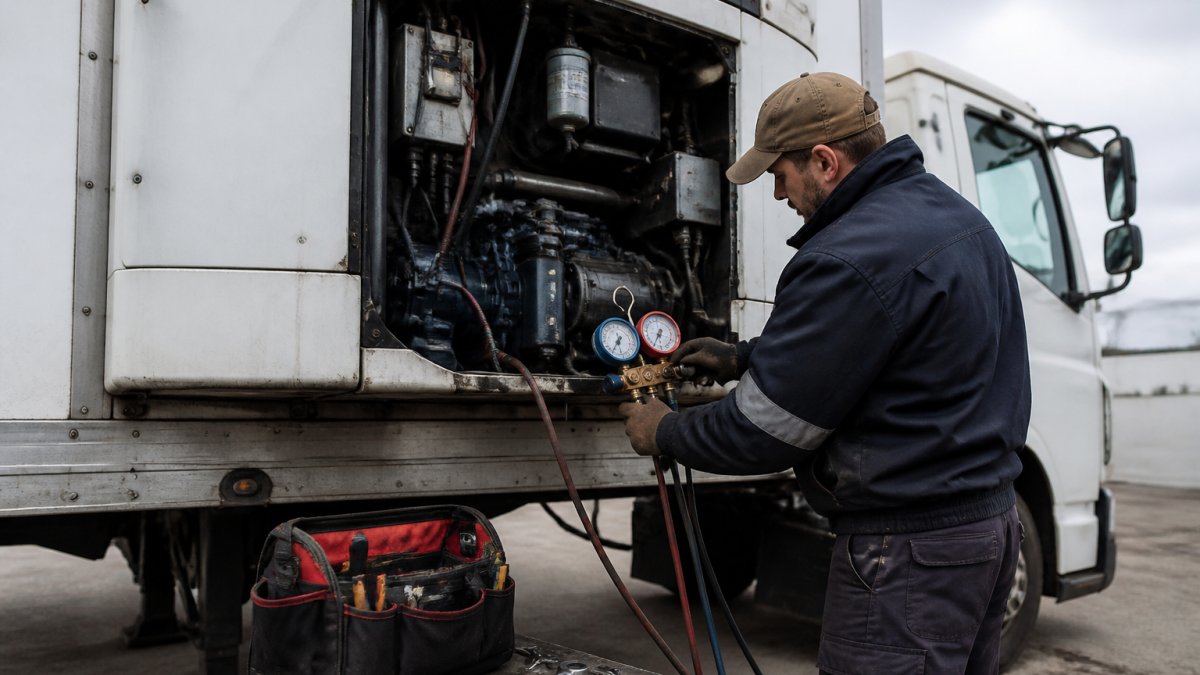
A mobile refrigeration mechanic is a certified technician who diagnoses, repairs, and maintains transport refrigeration units at your yard, dock, or roadside location instead of requiring you to haul the trailer to a shop.
At Platinum Transport Refrigeration Services, our work starts with the unit itself.

On-Site Service vs. Depot Repairs
Depot repairs make sense for planned overhauls and warranty work that requires a lift or a dedicated bay. Mobile service wins on everything else. A unit that leaves your yard for a depot can lose a day or more to travel, queue time, and pickup, and every one of those hours is a reefer not earning.
For Thermo King units specifically, you can see how that on-site model works in practice on our Thermo King repair service.
Refrigeration Mechanic Experience and Certifications to Verify
Ask for the EPA Section 608 certification first.
After that, verify manufacturer training. Dealer-level certification on the brands in your fleet indicates a technician has worked on your exact control systems.
Experience matters most when it is specific. A technician with years on commercial refrigeration and transport units will read a fault code more quickly than one with only HVAC or air conditioning background.
How to Verify Credentials and Insurance Before You Sign
Verification is a process, not a single question. Work through it in this order:
EPA 608 certificate. Ask for a copy and check the certification type against the refrigerant charge in your units. The certificate should be current and in the technician's name, not just the company's.
Manufacturer training records. Request the specific course completions for the brands you run. A general "factory trained" claim is not the same as a completed transport refrigeration course.
State and local licensing. Licensing requirements for refrigeration contractors vary by state and locality. Ask the company which license it holds and confirm it with the issuing authority rather than accepting a number on a business card.
Watch out: a company that hesitates to provide certificates of insurance or refuses to name its license number is telling you something. Treat reluctance as a disqualifier rather than a paperwork delay.
Our guide to mobile reefer technician certification requirements breaks down exactly which credentials to check before you accept a candidate's paperwork.
Questions to Ask a Refrigeration Repair Company Before You Sign
The right questions expose capability fast. Start with credentials and insurance, then move to how the company actually operates on a service call. Vague answers on any of these are your signal to keep looking.
Are your technicians EPA 608 certified, and can you show the certificates?
Which manufacturers have your techs trained at dealer level?
Do you carry parts for our specific unit models on the truck, or order them?
Questions Specific to Mobile Service Calls
Mobile adds a few questions a depot conversation never raises. Ask how dispatch works: who answers at 2 a.m., how the call is triaged, and whether the technician is sent from a stocked truck or a central warehouse. Ask what the truck actually carries, because "we stock parts" means little if the part for your unit is not on board.
Mobile Refrigeration Repair Cost: What Drives the Bill
Pricing for mobile refrigeration repair depends on the diagnostic time, the parts required, the refrigerant handled, and when you call. A scheduled daytime visit costs less than an emergency call-out at night or on a weekend, because after-hours dispatch carries labor premiums. Parts availability is the other big lever: a component on the truck bills as labor and part, while one that must be ordered adds downtime and often a second visit.
Mobile Service Call Fees, Explained
A mobile call carries costs a depot visit does not, and the quote should break them out. Ask for each of these in writing before you book:
Call-out or dispatch fee. A flat charge for sending a technician to your location, separate from labor and parts. Confirm whether it applies to scheduled visits or only to emergency calls.
Travel or mileage fee. Some providers charge for distance beyond a base radius. Ask what the radius is and what the per-mile rate is beyond it, so a yard at the edge of the service area does not produce a surprise line item.
Diagnostic fee. The charge for finding the fault. The key question is whether it is credited toward the repair if you approve the work. A credited diagnostic fee is standard among reputable providers; a non-credited fee plus a separate repair charge is where bills grow.
Arrival window. A firm window, not a vague "sometime today." Confirm whether the window is guaranteed and what happens if the technician arrives outside it.
What to Have Ready When You Book
A mobile call goes faster when dispatch has the right information up front. Have the unit make, model, and serial number ready, along with the fault code if the controller displays one, the cargo type and current setpoint, and the exact location and access details for the yard or roadside position.
Watch out: the cheapest quoted diagnostic fee often hides the real cost. Ask whether the diagnostic charge is credited toward the repair, whether there is a separate call-out fee, and whether the estimate is binding.
Emergency vs. Scheduled Maintenance Comparison
Service Type | Typical Trigger | Cost Profile | Downtime Impact |
Scheduled preventive maintenance | Planned interval | Lowest, predictable | Near zero, planned around routes |
Same-day mobile repair | Unit fault during the week | Moderate, diagnostic plus parts | Hours, not days |
After-hours emergency call | Breakdown outside business hours | Highest, labor premium applies | Hours if parts are stocked |
Depot overhaul | Major component failure | High, plus transport and queue | One or more days off the road |
The pattern is consistent: the more you plan, the less each repair costs and the less your fleet sits still. The mobile-specific fees above are what separate a transparent quote from a bill that only makes sense after the fact, so compare providers on the full fee structure rather than the headline hourly rate.
24-Hour Mobile Refrigeration Repair and Response Expectations
Genuine 24-hour mobile refrigeration repair means a technician is dispatched whenever a unit fails, including weekends and holidays. What separates providers is not the claim but the logistics behind it: stocked trucks, a real dispatch process, and coverage that reaches your yard.
Response speed also depends on where your fleet sits. You can see the emergency coverage we run, including after-hours dispatch, on our 24/7 emergency reefer repair page.
Transport Refrigeration and Cargo-Loss Risk During a Breakdown
A failed reefer is a food safety event, not just a maintenance ticket. Temperature-sensitive cargo, whether produce, dairy, frozen goods, or pharmaceuticals, has a limited window before it falls outside safe holding conditions, and that window shrinks fast in summer heat.
For a deeper look at the maintenance practices that cut breakdown risk, see our complete reefer unit maintenance guide.
Your Vetting Checklist and Decision Framework
Use this checklist before you sign with any mobile refrigeration provider. Score each line honestly; two or more gaps should end the conversation.
EPA 608 certification confirmed for every technician dispatched
Dealer-level training on the brands in your fleet
Written confirmation that parts for your models are carried on the truck
Service area covers every location your fleet operates from
Decision framework: If your fleet runs temperature-sensitive cargo and cannot absorb a day of downtime, prioritize mobile coverage and parts stocking over the lowest hourly rate. If your units are mostly under warranty and failures are rare, a depot relationship for major work plus a mobile provider for emergencies is a sound split.
Booking Mobile Refrigeration Service for Your Fleet
The practical next step is a coverage check. Confirm the provider's service area against every yard your fleet runs from, then schedule a first preventive maintenance visit so the technician can document each unit's condition before a failure forces the issue.
Platinum Transport Refrigeration Services provides 100% mobile reefer repair across the Tri-Cities and throughout Washington and Oregon, with 24-hour emergency dispatch and dealer-level technicians who carry a large variety of parts on-site. Confirm your locations on our reefer repair service area page, then call (509) 547-5262 to book a visit.
Breakdowns never schedule themselves around your routes. Get a mobile technician to your yard with dealer-level diagnostics and the parts already on the truck, so your reefers stay loaded and your cold chain stays intact.
Frequently Asked Questions
What should I look for when choosing a mobile refrigeration mechanic?
Start with credentials: EPA Section 608 certification for refrigerant handling, manufacturer training on the brands in your fleet, and proof of liability insurance. Then check mobile capability, meaning the truck carries common parts and diagnostic tools so most jobs finish on the first visit. Ask about response times for after-hours calls, whether pricing is quoted upfront, and which transport refrigeration systems they service. A mechanic who works mostly on building HVAC may not know trailer units well.
What questions should I ask a refrigeration repair company before hiring them?
Ask how they verify technician certification, what parts they stock on the truck versus order, and how they handle a 2 AM breakdown. Confirm whether they charge a diagnostic fee, a call-out fee, or both, and request a written repair estimate before work begins. Also ask which brands and equipment ages they support, how they document completed repairs, and whether labor and parts carry warranties. Their answers reveal whether they are set up for mobile fleet work or depot-style repairs.
What affects the cost of mobile refrigeration repair?
Several factors drive the bill: travel distance to your location, time of day (after-hours calls usually carry a premium), the diagnostic and call-out fees, parts needed, and whether the technician can complete the repair on the first visit. Units that are older or use less common parts may cost more. Ask for upfront pricing and an itemized estimate so you can compare providers on the same basis rather than on a single headline number.
How quickly can a mobile refrigeration mechanic respond to a breakdown?
Response time depends on dispatch logistics: how many trucks the provider runs, where they are based, and how they prioritize calls. A provider built around mobile service should give you a realistic window when you call, not a vague promise. Ask what their average response time is for your area and how they handle multiple simultaneous calls. For temperature-sensitive cargo, even a few hours of delay can matter, so confirm the window in writing before you need it.
Is 24-hour mobile refrigeration repair really available after hours?
It can be, but verify how it works. Ask whether a live person answers the phone at 2 AM, whether the on-call technician is dispatched directly or routed through a call center, and whether after-hours rates differ from daytime rates. A provider that genuinely runs 24/7 will explain its dispatch process clearly and give you a response window. If the answer is vague, assume after-hours service is limited.
How can I reduce downtime when a refrigerated unit breaks down?
Two moves help most: keep a preventive maintenance schedule so failures are caught before they strand a load, and choose a mobile provider that stocks common parts so first-visit repairs are the norm. When a breakdown happens, call immediately with the unit model, symptom, and location, and ask for a response window. Having a service agreement in place before an emergency means you are already in the dispatch queue instead of starting from scratch.
Comments