Mobile Reefer Technician Certification Requirements
Last Updated: November 11, 2026
Quick Summary
Mobile reefer technician certification requires an EPA Section 608 card for transport refrigeration units, formal training through HVACR programs or apprenticeships, and often OEM instruction such as a Thermo King course. There is no single national reefer technician certification, so you must also check state licensing rules where you perform the work.
EPA Section 609 covers truck cab AC, while Section 608 covers the transport refrigeration unit itself.
Most transport refrigeration work calls for EPA 608 Type II, and many technicians take the full Universal exam.
Apprenticeships typically run three to four years and are often paid while you learn.
Some states honor another state's HVACR license through reciprocity or license by endorsement; others require retesting.
A state license does not always satisfy city or county registration, so check municipal rules too.
Need certified reefer support today?
Platinum TRS brings 24/7 mobile reefer repair and dealer-level expertise to your fleet.
Table of Contents
Step 1: Understand What Mobile Reefer Technician Certification Requirements Cover
Step 2: Meet EPA Section 608 Certification for Refrigeration Technicians
Step 3: Complete Reefer Technician Training and Apprenticeship Hours
Step 4: Add OEM Instruction Like a Thermo King Reefer Training Course
Step 5: Check Transport Refrigeration Technician License Requirements
Step 1: Understand What Mobile Reefer Technician Certification Requirements Cover
Mobile reefer technician certification requirements are the mix of federal refrigerant credentials, formal training, and hands-on hours a technician needs before working on transport refrigeration units. Fleet managers often ask what "certified" actually means. The answer has three layers: an EPA refrigerant card, documented training, and often an OEM course.
A mobile reefer technician is a technician who services refrigeration systems mounted on trucks and trailers rather than in buildings. That distinction drives everything about the credentials.
Mobile vs. Stationary: Why the Distinction Matters
The split between mobile and stationary refrigeration changes which rules apply. Stationary work covers building chillers, walk-in coolers, and industrial refrigeration. Mobile work covers transport refrigeration units bolted to trailers and truck bodies.
Federal refrigerant rules treat these two worlds differently. That single fact trips up more new technicians than any other part of the process.
Mobile units need EPA Section 609 for motor vehicle air conditioning
Stationary and transport units typically fall under EPA Section 608
Transport refrigeration straddles both, so many technicians hold both cards
Get this wrong and you can pass a course that doesn't cover the equipment you actually service.
Step 2: Meet EPA Section 608 Certification for Refrigeration Technicians
EPA Section 608 certification is the core credential for anyone who handles refrigerants in stationary and transport refrigeration systems. It comes from the EPA refrigerant management requirements and covers safe handling, recovery, and recycling.
The exam has four sections: Core, Type I, Type II, and Type III. Most transport refrigeration work calls for Type II, which covers high-pressure systems. Many technicians take the full Universal exam to keep their options open.
Here's what the test generally covers:
Refrigerant recovery and recycling rules
Leak detection and repair
Safe handling and pressure testing
Environmental regulations and recordkeeping
EPA 608 vs. EPA 609: Which Applies to Mobile Units
EPA 609 applies specifically to motor vehicle air conditioning, the cab cooling in a truck or the AC in a passenger vehicle. EPA 608 applies to the transport refrigeration unit itself, the box that keeps cargo cold.
A trailer reefer running R-404A needs a Section 608 technician. A truck cab AC system needs Section 609. Many mobile reefer mechanics carry both because they work on the whole vehicle.
If you're unsure which card a job requires, check the equipment type before you touch it. Handling refrigerant without the right credential is a compliance problem, not just a paperwork gap.
Step 3: Complete Reefer Technician Training and Apprenticeship Hours
Formal reefer technician training comes through community college HVACR programs, trade schools, and manufacturer courses. A typical program runs from several months to two years and blends classroom work with lab time on real equipment.

Apprenticeship hours build the field experience employers actually want. Apprenticeship programs vary in length, and hour requirements depend on the program. Those hours cover:
Refrigerant handling and recovery
Electrical diagnostics on control circuits
Diesel engine integration and belt systems
Preventative maintenance routines
System troubleshooting under load
Step 4: Add OEM Instruction Like a Thermo King Reefer Training Course
OEM training is manufacturer-specific instruction on a particular brand of equipment. A Thermo King reefer training course teaches the controllers, fault codes, and service procedures unique to that brand. Carrier offers parallel programs for its units.
This layer isn't usually a legal requirement. It's what separates a technician who can read a manual from one who can diagnose a fault in minutes.
If your fleet runs mixed brands, look for service partners who carry OEM-level training across the units you operate. You can see Thermo King-specific support through Thermo King repair or compare the Carrier side with Carrier reefer repair.
Step 5: Check Transport Refrigeration Technician License Requirements
Transport refrigeration technician license requirements vary by state, and there is no single national license for reefer work.
Start with the state licensing board where you will perform the work, not where your company is headquartered. The rules usually cover:
Whether a contractor license is needed to bill for work (most states require one to advertise or contract for HVACR services)
Insurance and bond requirements
Continuing education requirements for license renewal
Exam requirements beyond the EPA card
Whether an apprentice or helper can work under a licensed contractor's supervision
State Licensing and Reciprocity
Reciprocity is where mobile technicians get stuck, and it is the part competitors gloss over. A few patterns repeat across state boards:
Formal reciprocity agreements. Some states honor another state's HVACR license through a written agreement, usually requiring the license to be in good standing and sometimes requiring a short residency or application period.
License by endorsement. Other states skip the written trade exam for an out-of-state licensee but still require the business-law exam and a fee.
No reciprocity. Many states require you to test again or work under a locally licensed contractor, even if you have held a license elsewhere for years.
Municipal overlays. A state license does not always satisfy city or county registration, so a technician cleared for one metro can still be unregistered a county over.
Technicians who cross state lines should check the licensing rules of each state where they plan to work. The EPA credential is federal, while state licenses are issued by individual states.
Before taking a job across a state border, confirm the licensing rule with the state licensing board.
What Certification Costs and How Long It Takes
Costs vary widely by path, so a new technician should budget by line item. The total investment breaks into four buckets: the EPA exam, formal training, OEM courses, and the tools and insurance that come with the trade.
Path | Typical Duration | What It Delivers | Cost Bucket |
EPA 608 exam only | A few weeks of study | Federal refrigerant card | Exam fee plus study materials |
Community college HVACR program | Several months to two years | Broad technical foundation | Per-credit tuition plus lab fees |
Apprenticeship | Three to four years | Field experience and hours | Often paid while you learn |
OEM brand course | Days per class | Brand-specific diagnostics | Per-class registration, sometimes travel |
Here is how each bucket usually works in practice:
EPA exam. Section 608 exams are administered by third-party testing organizations that set their own fees. Study materials are typically sold separately.
Formal training. Program pricing varies between community colleges and private trade schools, so compare total costs directly.
OEM courses. Manufacturer course pricing and eligibility rules vary by OEM.
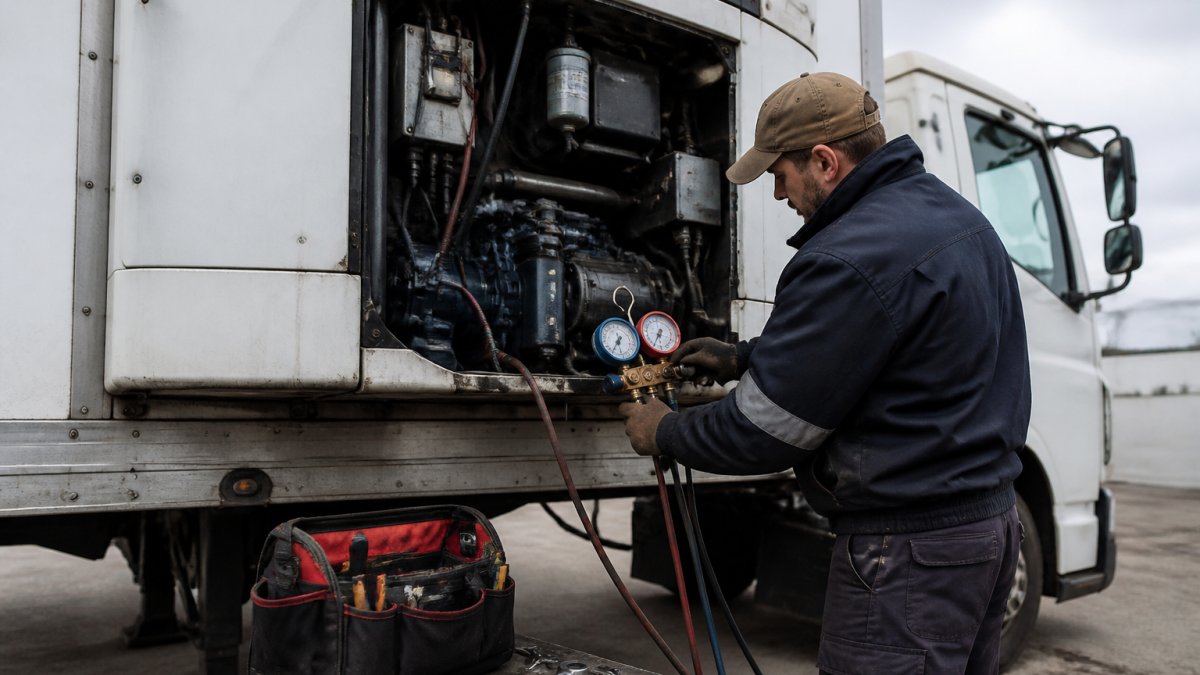
Tools and insurance. A technician entering mobile work needs gauges, a vacuum pump, recovery equipment, leak detectors, and a multimeter at minimum. Contractors may also need liability insurance and, in some states, a surety bond.
For current exam and program pricing, check with the testing provider or school directly.
Build the Skills Mobile Work Demands
Mobile reefer work asks for skills a shop-based technician never develops. You diagnose on the road, often without a lift, a full parts room, or a second set of hands.
The skills that matter most in the field:
Electrical diagnostics on control circuits and sensors
Refrigerant leak detection under vibration and road stress
Pressure testing without shop air
Diesel engine integration knowledge for belt-driven units
Preventative maintenance scheduling across a fleet
Mechanical aptitude gets you in the door. Diagnostic discipline keeps you working. A technician who can trace a fault through a controller and a wiring harness is worth far more than one who only swaps parts.
Hire Certified Mobile Reefer Support for Your Fleet
Building a certified technician pipeline takes years. Most fleets don't have that time, and running reactive maintenance until something fails puts temperature-sensitive cargo at risk.
That's where a mobile service partner earns its place. Platinum Transport Refrigeration Services provides 24-hour emergency reefer repair, 100% mobile service, dealer-level expertise, and a large variety of parts carried on-site.
You can check 24/7 emergency reefer repair for urgent breakdowns, confirm coverage with our reefer repair service area, or book online to request mobile diagnostics and repairs.
Certified technicians are hard to find and harder to keep. If your fleet needs dealer-level support now, Platinum Transport Refrigeration Services brings 24-hour mobile repair, on-site parts, and OEM-level expertise directly to your units. Get started with Platinum Transport Refrigeration Services and keep your cold chain running without the downtime.
Frequently Asked Questions
What certificates do reefer mechanics need?
Mobile reefer mechanics need EPA Section 608 certification to handle refrigerants legally, and often EPA Section 609 for motor vehicle air conditioning work. Beyond that, OEM training such as Thermo King or Carrier Transicold courses strengthens credentials, and some states require a refrigeration license. Employers also look for apprenticeship hours and demonstrated mechanical aptitude. The exact mix depends on whether you service transport refrigeration units, stationary systems, or both.
Does a reefer technician need EPA Section 608 certification?
Yes. Anyone who services, repairs, or disposes of equipment containing regulated refrigerants must hold EPA Section 608 certification under the Clean Air Act. Transport refrigeration units using R-404A and similar refrigerants fall under this rule. The exam covers refrigerant handling, recovery and recycling, leak detection, and safety compliance. Passing the core section plus Type II or Universal is typical for reefer work because these systems use high-pressure refrigerant circuits.
Do refrigeration technicians need a state license?
It varies by state. Some states require a refrigeration contractor or technician license, while others rely on EPA certification alone. Licensing rules also differ for stationary versus mobile refrigeration systems, and reciprocity between states is limited, so a license earned in one state may not transfer. Check the licensing board in the state where you plan to work before enrolling in a training program, since requirements can affect both your coursework and your exam timing.
How long does it take to get reefer technician certification?
EPA Section 608 certification can be earned in a few weeks through a prep course and exam. Program length depends on whether you pursue a certificate or associate degree. Apprenticeship length varies by program. OEM courses are typically short and scheduled around full-time work.
Comments